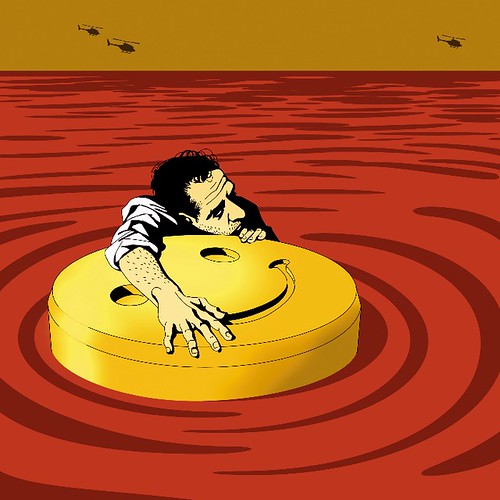
Illustration of a veteran being saved from the debilitating effects of war trauma by the drug ecstasy.
Anyone who has ever taken the infamous club-drug ecstasy (MDMA) knows how the intoxicating effects of the substance can frequently lead to overwhelming feelings of “love” towards most things the user comes into contact with, which often includes things that are normally disliked and thus typically avoided. Although long-term abuse of this drug can certainly be dangerous, researchers are beginning to find that, when used appropriately, this “love drug” can also be an important medicine for helping alleviate symptoms of certain mental illnesses. Specifically, studies are beginning to find that MDMA in combination with psychotherapy can be an effective treatment for post-traumatic-stress-disorder (PTSD). It is important to note, however, that this groundbreaking work would likely be non-existent if not for the Multidisciplinary Association for Psychedelic Studies (MAPS), a non-profit research and educational organization which funds various projects that investigate the therapeutic applications of psychedelic drugs. The fact that their research has recently been featured on major news networks like CNN is a glowing testimony to both the medical legitimacy and social relevance of their work.
So how exactly does MDMA help treat PTSD? Well, in layman’s terms, the “loving” effect of the drug causes one to be much more emotionally open than normal. This increased access to emotions can be extremely helpful in the process of breaking through various resistances or psychological defenses, which is essentially the goal of most therapeutic interventions. The ability to break through resistances is especially important when working with PTSD, given that a major part of this malady is perpetuated by a seemingly hard-wired instinct to avoid unpleasant emotions (e.g., fear) related to the initial trauma. Ecstasy can help with this by assisting “people in confronting memories, thoughts and feelings related to the trauma without increasing either fear or avoidance in response to this confrontation. An increase in self-acceptance and increased feelings of closeness to others may also assist people with PTSD in forming a therapeutic alliance with psychotherapists.” This suggests that ecstasy has the unique potential to considerably expedite the process of normal psychotherapy. {For more info on possible biological explanations for ecstasy’s success in treating PTSD click here.}
Besides the obvious factor of the negative stigma attached to ecstasy, the FDA is in no rush to fund research on MDMA-assisted psychotherapy primarily because the pharmaceutical industry has no compelling (i.e., financial) interest in making MDMA into a prescription drug. The financial incentive is lacking because MDMA-assisted psychotherapy consists of only a few administrations of the drug “within the context of a time limited course of non-drug psychotherapy over three to four months (8).” Again, ecstasy is being shown as an effective treatment for PTSD after being administered on only a small number of occasions. In contrast, drugs that are currently accepted by the FDA for treating PTSD (e.g., Paxil) are big money-makers because they are prescribed for daily use over long periods of time, if not for life.
And so it goes with Big Pharma’s monopoly on medical treatment. Thank Yahweh for the good people at MAPS for actively challenging this retarded system.
Check out one of their new promos:
~Wolf


