Showing posts with label God. Show all posts

4.15.2011

The fruitless search for self

We are all wired into a survival trip now. No more of the speed that fueled that 60s. That was the fatal flaw in Tim Leary's trip. He crashed around America selling “consciousness expansion” without ever giving a thought to the grim meat-hook realities that were lying in wait for all the people who took him seriously. All those pathetically eager acid freaks who thought they could buy Peace and Understanding for three bucks a hit. But their loss and failure is ours too. What Leary took down with him was the central illusion of a whole life-style that he helped create; a generation of permanent cripples, failed seekers, who never understood the essential old-mystic fallacy of the Acid Culture: the desperate assumption that somebody—or at least some force—is tending the light at the end of the tunnel.

So wrote Hunter S. Thompson as he reflected on the rise and fall of LSD as a viable door of perception. Dropping acid in the sixties was often an act of rebellion against ubiquitous materialism and consumerism. Like religion, it was used as a tool to apprehend something transcendently meaningful. It satisfied an age-old psychological urge by helping create the impression that some force is indeed tending the light at the end of the tunnel.

These days LSD is largely out of fashion. The kinds of people who would’ve taken acid in the sixties today resort to weed, meth, and other drugs whose chief effect is not “consciousness expansion,” but consciousness numbing. Rather than actively seek a path to illusory enlightenment, the chief aim of drug use today is mere psychological aloofness. Of course, smoking endless bales of marijuana is hardly a prerequisite for entry into the counterculture, which today is characterized by a fair amount of nonchalant douchebaggery in the form of nihilistic hipsters who seek meaning—but only ironically—through half-baked art house performances of topless body painting and male go-go dancing set to the theme song of Golden Girls, all while the audience samples fine artisanal cheeses.

But enough about the skin-tight jeans faction. How has the rest of America been coping with the constant cacophony of chaotic commercialism? To answer this, one need only consult the latest list of bestselling nonfiction paperbacks. Here is a sampling of titles.

Heaven is for Real. “A boy’s encounter with Jesus and the angels.”

Have a Little Faith. “A suburban rabbi and a Detroit pastor teach lessons about the comfort of belief.”

Drive. “A look at what truly motivates us, and how we can use that knowledge to work smarter and live better.”

90 Minutes in Heaven. “A minister on the otherworldly experience he had after an accident.”

Eat, Pray, Love. “A writer’s journey in search of self takes her to Italy, India and Indonesia.”

The Checklist Manifesto. “The power of a simple idea to manage the increasing complexity of life.”

If the popularity of these books is any indication, the search for self is not only underway, but profitable. Indeed, “self,” not space, may very well be the final frontier. But the average American’s self, like space, is a vast expanse of nothingness containing just a few if any fleeting flashes of supernova-like brilliance that must ultimately give way to destitute black holes capable of only consumption, not creation. Hence the insatiable consumerism and the path of devastation it leaves in its wake. This realization is what awaits all honest seekers of self. Unfortunately—or perhaps fortunately—very few will arrive at this point. Indeed, humans may have even developed an internal survival mechanism to prevent such a realization from occurring. At least, people in the United States seem to have. It is difficult to imagine America producing a Camus, for example, for the plain fact that his ideas threaten the American dogma that one must exist for something else—god, spouse, children, society, etc.—instead of existing for existence’s sake.

Like the cockeyed acid heads before them, today’s group of self-seekers assumes that some cosmic manager is minding the store. With science’s destruction of faith-based explanations for natural phenomena virtually complete, and the creeping absurdism that accompanies it, we can now perceive the rise of a one-size-fits-all “spirituality” that is slowly encroaching upon the territory of Old Time Religion. Of course, the die-hards will remain, praising Jebus and whatnot until their dying breath. But as for the rest, they will become increasingly receptive to the gobbledygook preached by Wayne Dyer, Tony Robbins, Mitch Albom, and other garbage salesmen who incorporate a elusive spiritualism that on one hand satisfies the American need for religious mumbo-jumbo, while on the other is so vague that it can appeal to anyone who thinks there has to be something “out there.”

But there is nothing out there—nothing that can possibly be ascertained by our mortal minds, anyway. And not only is there no one tending the light at the end of the tunnel, there is no light at all.

4.07.2011

On the Afghan response to the Florida BBQur'an

“A believer wounded by the nonbelievers. A nonbeliever wounded by the believers.”

Cited in Le Devoir

During his first year in office, President Barack Obama justified his decision to send an additional 30,000 soldiers to Afghanistan by declaring, “We’re in Afghanistan to prevent a cancer.” Recalling the perpetrators of the September 11th attacks, he said,

As we know, these men belonged to al Qaeda – a group of extremists who have distorted and defiled Islam, one of the world’s great religions, to justify the slaughter of innocents….

[S]hortly after taking office, I approved a long-standing request for more troops. After consultations with our allies, I then announced a strategy recognizing the fundamental connection between our war effort in Afghanistan, and the extremist safe-havens in Pakistan. I set a goal that was narrowly defined as disrupting, dismantling, and defeating al Qaeda and its extremist allies, and pledged to better coordinate our military and civilian effort.

Islam-inspired extremism, then, is the enemy thus defined. Fast forward to April Fool’s Day last week, when over one thousand rioters in the Afghan city of Mazar-i-Sharif were certainly not fooling when they killed seven United Nations employees and beheaded two of them. This was the mob justice meted out in response to the burning of a Qur’an by a pastor in Florida, quite obviously a development with which the UN workers had nothing to do. Clearly, Obama is right to be concerned about “al Qaeda and its extremist allies,” but what is particularly instructive about this savagery is that it occurred in a city that is under the control of the US-backed government led by the corrupt Hamid Karzai, who according to a New York Times article, actually helped incite the rioters:

Both Afghan and international news media had initially played down or ignored the actions of [Terry] Jones, the Florida pastor. On Thursday, however, President Karzai made a speech and issued statements condemning the Koran burning and calling for the arrest of Mr. Jones for his actions. On Friday, that theme was picked up in mosques throughout Afghanistan.

“Karzai brought this issue back to life, and he has to take some responsibility for starting this up,” said a prominent Afghan businessman, who spoke on the condition of anonymity for fear of retribution if he was identified as a critic of the president.

If it’s extremists President Obama is after, he need look no further than the Karzai government he supports; not to mention the depravedly excitable people of Mazar-i-Sharif, who represent not an insubstantial faction of religious zealots who are not in an officially designated terrorist organization. With citizens of a US-allied government like these, who needs al Qaeda?

- Max

4.01.2011

Muslim savages behead UN workers in Afghanistan in response to Koran burning in Florida

MAZAR-I-SHARIF, Afghanistan — Stirred up by a trio of angry mullahs who urged them to avenge the burning of a Koran at a Florida church, thousands of protesters overran the compound of the United Nations in this northern Afghan city, killing at least 12 people, Afghan and United Nations officials said.

The dead included at least seven United Nations workers — five Nepalese guards and two Europeans, one of them a woman. None were Americans. Early reports, later denied by Afghan officials, said at least two of the dead had been beheaded…

Unable to find Americans on whom to vent their anger, the mob turned instead on the next-best symbol of Western intrusion — the nearby United Nations headquarters. “Some of our colleagues were just hunted down,” said a spokesman for the United Nations Assistance Mission in Afghanistan, Kieran Dwyer, confirming the attack.

New York Times

Once again Islam’s theocrackpots have held up their “religion of peace” for all to see. What does it say about the level of fanaticism when the desecration of a Koran by redneck pastor Terry Jones, (who last year threatened to, but ultimately did not burn the Koran) thousands of miles away can whip up a mob up into a homicidal frenzy to the point where its members feel justified in targeting anyone who appears to be from the West?

Here’s one fascist trying to explain the situation:

A prominent Afghan cleric, Mullah Qyamudin Kashaf, the acting head of the Ulema Council of Afghanistan and a Karzai appointee, also called for American authorities to arrest and try Mr. Jones in the Koran burning.

The Ulema Council recently met to discuss the Koran burning, Mullah Kashaf said in a telephone interview. “We expressed our deep concerns about this act, and we were expecting the violence that we are witnessing now,” he said. “Unless they try [Terry Jones] and give him the highest possible punishment, we will witness violence and protests not only in Afghanistan but in the entire world.”

So it isn’t these infantile Muslim sadists, with their uncanny inability to handle news of an isolated incident of blasphemy in some faraway land, who have the problem. It’s the United States, with its freedom of speech and expression. It’s because Terry Jones and every other American has the right to physically and verbally trash the Koran, the Bible, the Bhagavad-Gita, or Tuesdays with Morrie from now until the First Amendment is repealed.

Of course some liberals will be inclined to condemn not just the murderers themselves, but Terry Jones as well. Not me. While Jones’s religion is also bunk, and I have no doubt that he is probably one of the most ignorant hayseeds in the hemisphere, the man has a right to do what he did. Only a true miscreant would take such umbrage as to say he has blood on his hands. The collective psychosis on display in Mazar-I-Sharif is a display of barbarism that can only be explained by the irrational devotion to Islam.

Fuck the Koran, fuck Mohammed, and fuck Islam, which is a heinous, evil abomination.


- Max

3.26.2011

Atheism and morality (Part 2 of 3)

In my previous post I addressed the oft-repeated claim by believers that god/religion/holy books provide an objective moral benchmark by pointing out that this morality is hopelessly vulnerable to selective and flawed execution. I hasten to add that even when such principles are universally applied, the results are frequently ghastly. One need only think back to the time when the Catholic Church, with its absolute standards of morality, reigned supreme over Europe. This epoch is called the Dark Ages for a reason, and the presence of an objective system of morals was of no consolation to those who were persecuted in accordance with its precepts.

Rabbi Adam Jacobs claims that when Sam Harris and other atheists condemn the Taliban (or anyone else) for engaging in objectionable behavior, they are betraying the principles of atheism, which for Jacobs includes rampant moral relativism. This is because atheism is the rejection of deities, and for him deities are the only things capable of advancing objective moral guidelines. By implication, the theist is in a far better position to decry as immoral the acts of the Taliban. But does not the Taliban feel its actions are guided as much by their understanding of divine law than Rabbi Jacobs is of his? In this regard, the problem is not godless moral relativism, but competing religious moral absolutisms.

Not content with accusing atheists of nihilism, Jacobs hurls this insult:

“At the end of the day, the reason that I can agree with many of the moral assertions that these atheists make is because they are not truly outgrowths of their purported philosophies, but rather of mine. I would suspect that the great majority of the atheistic understanding of morality comes directly or indirectly from what is commonly referred to as the Judeo-Christian ethic. I have not yet found an atheist who is willing to follow his or her convictions through to their logical conclusions (outside of sociopaths like Jeffrey Dahmer who was at least honest enough to say, ‘I always believed the theory of evolution as truth that we all just came from the slime ... if a person doesn’t think there is a God to be accountable to then what’s the point of trying to modify your behavior to keep it within acceptable ranges?’ [sic, no closing parenthesis]”

There you have it. Neither Jeffrey Dahmer nor Rabbi Adam Jacobs can imagine a reason for behaving oneself in the absence of a supernatural entity that promulgates and monitors morality. I suppose what the rabbi is confessing here is that if he stopped believing in god today, he would turn into Mr. Hyde—or Jeffrey Dahmer—tomorrow.

As to Jacobs’ contention that the morality of atheists is in fact the residual influence of the “Judeo-Christian ethic,” that is wishful thinking and spoken like a true arrogant religionist. Read the books of the Old Testament and see how much of the “Judeo-Christian ethic” you actually assent to or would deem fit to teach a child for that matter. These books are replete with god-sanctioned genocide and homicide, contain obscure commandments that not even the most ardent of the faithful follow or even know about, and prohibits certain sexual activity that only a truly neurotic deity could care anything about, among other abominations. It should also be added that of all the commandments found in the Old Testament, not one says anything like, “Thou shalt not rape.” I am quite certain that Sam Harris, other atheists, and Rabbi Jacobs himself think that rape is bad, but if that’s the case, then on whose authority do they form such an opinion?

If the bible contains any provisions which have been codified in the laws of our modern society, this is only a happenstance. Believers pick and choose which commandments they follow as evidenced by their following of rules not put forth by the deity, and their neglect of those that are. The implication here is clear: humans are capable of forming a set of morals independent from divine sanction.

Not only does Jacobs conveniently ignore the selective application of his beloved objective morality, he fundamentally misunderstands evolution:

“Is not [Christopher] Hitchens an ardent supporter of the tenets of Neo-Darwinism that necessitates the perpetual death struggle within all species at all times? Shouldn't he in fact believe the precise opposite of what he claims? Survival of the fittest does not suggest social harmony.”

A more fatuous point would be difficult to imagine. Anyone who has stopped often and long enough to observe wildlife will notice that a general peace exists among animals of a particular species, and often animals of different species. In my travels I find that squirrels are the most abundant mammal, and I see several of them each day. And yet, not once in my years of observing thousands of squirrels have I observed one squirrel attacking another. This is not to say this doesn’t happen or that squirrels do not kill one on another on occasion, because they surely do. However, squirrels have no sense of divine morality, and so according to Jacobs’ logic, there could be no expectation of social harmony among these creatures. And yet there is. Take any species. No doubt it happens that rams or giraffes or sharks, etc. attack each other (especially when females are involved), but these are rare occasions. No population of species whose members are engaged in a “perpetual death struggle” with each another would last very long. Without question living things are engaged in a competitive struggle, but rarely must the survival of a member of one species involve the demise of another member of same. In many cases, it is quite the opposite.

- Max

Part One

3.24.2011

Atheism and morality (Part 1 of 3)

Consult a preacher about morality and he will tell you that like everything else, it is a gift from god. Without this divinely imparted sense of right and wrong, you will be told, all would be lost. There would be no standard for human behavior other than for each person to act as his own conscience dictates. Without this god-given morality, the world would be marred by chaos, uncertainty, and unspeakable acts. A true Hobbesian jungle in which there is no “objective” way to view human behavior.

Such is the critique by Rabbi Adam Jacobs on Huffington Post, which seems to have an endless supply of rabbis and other unimaginative clergymen whose thinking is limited by a belief in celestial magic. I am not very much interested in specifically critiquing Rabbi Jacobs since he makes a charge against atheists that so many others have made and will continue to make. I will however, quote one relevant paragraph because it typifies this kind of accusation:

“What I do not yet understand is why [Sam Harris] (or any atheist for that matter) makes so many moral proclamations. The average atheist makes certain basic assumptions about reality: that we all exist as a result of blind and purposeless happenstance, that free will is illusory, that there is no conscious ‘self’ and that there is no objective right or wrong. As Dr. Will Provine has said, ‘[as an atheist] you give up hope that there is an imminent morality…you can’t hope for there being any free will [and there is]…no ultimate foundation for ethics.’”

He goes on to say that to be an atheist is to be amoral because atheism does not allow for an objective standard of morality. According to Jacobs, only theism can provide this much needed behavioral benchmark. And so any pretense on the part of atheists to be able to judge right from wrong is actually a subjective exercise because, well, on whose authority are such judgments being made?

This is the reasoning of a slave. The notion that a divine engineer is necessary to provide universal norms of behavior is one that recurs everywhere—among Jewish populations, Christian populations, Muslim populations, and so on. Such is the purpose of religion, to provide an explanation for life—its nature and meaning, as well as how it ought to be lived. This is morality by revealed wisdom. No thinking necessary.

One immediate problem with Jacobs’ view is the sheer of volume of disagreement on moral questions that believers in god have amongst each other. Take for example, the Ten Commandments, the most famous and perhaps the most important divine moral instructions for those in the Judeo-Christian tradition

The Sixth Commandment admonishes, “Thou shalt not kill.” This seems a straightforward dictum. And yet believers of all kinds cannot seem to agree on a whole range of issues in which this commandment is a central concern. Ask a group of Catholics, or Protestants, or Jews about the death penalty, or if and when it is ever morally acceptable to use lethal self-defense, or if it is ever right to kill in war. See if you can find a uniformity of opinion with respect to any of these questions, even among members of the same faith.

Or take, “Remember the Sabbath; to keep it holy.” Jews and Christians do not even agree on which day the Shabbat falls. Nor do they agree on what kinds of activities can be performed on that day. And while we’re at it, why is it that Christians and kosher Jews do not see eye to eye on the matter of pig consumption? They are after all praying to the same Yahweh.

How about, “Honor thy father and thy mother”? What form shall this honoring take? Is the honor to be bestowed even on those parents who are negligent or abusive? What exactly is so “objective” about this or any of the aforementioned instructions? One could go on in this fashion for days, but I’m sure you can think of your own examples of Biblical or Koranic ambiguity. Clearly, even when morality is assumed to emanate from divine wisdom, these rules still lend themselves to subjective interpretation.

Granted, Jacobs and his ilk might very well concede the above points without agreeing that they have damaged the contention that atheists must necessarily be amoral or that divine sanction is a prerequisite for moral objectivity. One of the more interesting (and wrong) arguments I’ve heard that defend this position admits that religion is flawed because it is a “human endeavor,” which is to say it’s as corruptible as anything else. In which case, what is religion for?

- Max

Part Two


3.22.2011

The faitheism of S.E. Cupp


The underrated Cambridge philosopher G.E. Moore once mused on the absurdity of stating a fact, but then claiming to believe its opposite. For example, the sentence, “S.E. Cupp is attractive, but I don’t believe she is,” while not a contradictory statement in and of itself, nonetheless conveys contradictory ideas. A statement like this is an absurd declaration that no rational person could utter with any sincerity. To assert A is to believe A (unless one is lying). Notice that what matters is not whether A is actually true or false, but whether A is being asserted or not. In a similar fashion, it is equally absurd to assert not-A, but believe A, e.g., “I didn‘t get an email from John, but I believe I did.”


Thankfully, real-world instances of Moore’s Paradox are few and far between, if they exist at all. But Cupp, the popular conservative columnist, author, and self-proclaimed atheist dangerously straddles the line demarcated by Moore’s Paradox that separates the world of rational thought from the world of total incoherence. There may not be another creature like her on the planet. Whether she truly holds wildly contradictory beliefs about faith and atheism, or, by calculated contrivance is carving out a profitable niche for herself as a nonbelieving defender of the faithful, we cannot know for sure. All we have are her words on the subject, and they make no sense at all.


Everything you need to know about atheist Cupp, author of Losing Our Religion—an attack on atheists (you heard right)—and her brand of nonbelief can be gleaned from this portion of an interview she gave to C-SPAN in 2009. Explaining her rejection of religion, she told interviewer Brian Lamb:


“I didn’t buy it. It wasn’t for me. But I’m envious. I’m envious of the faithful. So I defend the faithful, especially the Christian Right in America at every opportunity I get….I haven’t closed the door on faith. It just hasn’t found me yet.”


Yet?


“I don’t believe in a higher power of any kind. No deity whatsoever. I really believe that when I die I go in the ground like every other animal and that’s that.”


That’s good.


“I aspire to be a person of faith one day.”


What? What does that even mean? Becoming a person of faith isn’t like becoming a CPA. There’s no training or certification process. To say you aspire to be a person of faith one day makes as much sense as saying at some point you hope to be a postmodern feminist. Here’s a person who’s basically saying that she sees no good reason for believing in a deity, but that one day she hopes to believe in a deity that presently she does not think exists. In other words, “God doesn’t exist, but I hope I will believe he does.” Cupp hasn’t contradicted herself here, but this view is nevertheless bizarre.


The interview takes an even stranger turn when she starts heaping praise on George W. Bush:


"I’m a fan of George Bush…I think he had a conviction, personal principles that required him to answer to someone else when he went to bed at night. Not to the state and not to himself. I don’t see the same kind of reverence in some of our other recent presidents. Barack Obama included. Bill Clinton included. That gives me comfort as a citizen, knowing that my president is going to bed answering to a higher power. So he’s thinking about the decisions he’s making, not just because they’re going to affect him and his legacy, but because he has someone or something to answer to. I really respect that. And I think that whether you liked his policies or not, he really did what he thought was best for the country. And I think that’s really really rare."


At this point, Lamb asks what is no doubt on just about every viewer’s mind. Here is the rest of the exchange:


Lamb: If you don’t believe at all, why would you then follow somebody that has that as their way of life?


Cupp: As an atheist, I could never imagine electing, voting for an atheist president for exactly those reasons. I mean, religion keeps a person who is endowed with so much power honest. This is a person who is answering to a higher power every night. And not to the state. He doesn’t think that the state has all the power and he doesn’t think he himself has all the power. That’s important to me. I mean, I represent two percent of the world. Why would I, why would I want someone who thinks that 98% of the world is crazy running the country?


Lamb: [Composed but incredulous] But you don’t think that that higher power exists.


Cupp: I don’t. But I don’t think people are crazy. I understand the allure of religion. I really do. I’m just not going to be dishonest and say I believe in something I don’t yet.


Lamb: But what if he’s hearing voices all the time and taking advice from a higher power that doesn’t exist in your opinion, and makes decisions based on the higher power that doesn’t exist in your opinion?


Cupp: Well, I mean, people’s faith—it’s very personal, and I don’t judge the way that people use their faith to inform their decisions. I really don’t. We can judge him on his policies, whether he heard it from a voice in his head, he got it from the bible, he had a conversation with Laura one night over dinner. I mean, it doesn’t really matter to me. I’d like to judge the policies on face value.


Sensing an impasse, the interviewer moves away from Cupp’s whirlwind opinions on religion to spare the audience from further decreases in IQ.


Several statements stand out here. Let’s start with,


“That gives me comfort as a citizen, knowing that my president is going to bed answering to a higher power.”


Now, it’s one thing for Christians or Muslims or other theists to say this. After all, they believe in said higher power. But what about Cupp, who doesn’t? What are we to make of the person who essentially says, “I don’t believe in a higher power, but I’m glad the president answers to it”? As Lamb pointed out, she doesn’t believe in that higher power, so how could that possibly give her comfort? If anything, it should concern her that her president is getting guidance from a nonexistent entity. One has to seriously wonder whether Cupp thinks that a schizophrenic who receives instruction from benevolent voices is better qualified for the presidency than an atheist.


Her response is full of specious generalizations and tacit self-deprecation:


“As an atheist, I could never imagine electing, voting for an atheist president for exactly those reasons. I mean, religion keeps a person who is endowed with so much power honest. This is a person who is answering to a higher power every night. And not to the state.”


First of all, Cupp says she is an atheist, which is to say she believes that religion is false and deities are nonexistent. Yet simultaneously she insists that believers in such falsehoods are the only ones qualified to be president precisely because they believe in god. Ok?


Second, Cupp is claiming that the religious are made more honest because they believe in what she herself thinks is a false doctrine.


Third, the idea that god kept Bush honest is betrayed by his administration’s penchant for mendacity and deception. Also, how honest and decent are the ruling mullahs in Iran being kept by their higher power? Or the 9/11 hijackers? Or the people who blow up abortion clinics and murder doctors in the name of their higher power? And what about the fact that Bush’s former top advisor, Karl Rove, is an atheist? Rove was arguably the most influential man in the life of Bush the candidate and the Bush president, and yet he answered to no higher power.


Fourth, implicit in Cupp’s assessment is an admission that she would not vote for herself for president because she presumably would not be kept honest by a higher power since she does not believe in one. In which case, how could we trust anything she says?


But Lamb hits a home run with his question, But what if he’s hearing voices all the time?


Realizing she can’t reason her way out, she backtracks somewhat, now saying she judges the president based on his policies. She’s a conservative, and so if a president has conservative policies that match up with her political beliefs, she’s going to view him favorably. As she just said, she takes a policy at face value, and said it doesn’t matter how he arrives at it, whether “he got it from the bible [or] he had a conversation with Laura one night over dinner.”


So Cupp goes from saying that only believers should be president, to admitting it doesn’t matter how the president makes the decisions he does, just as long as they make for good policies, which for her means “conservative,” while seemingly maintaining her position that atheists like herself shouldn’t be president.


What do we call this position, where a person believes that what she believes to be false must be believed as true by another as a prerequisite for being awarded a special privilege, in this case the presidency? (I suppose this take would be fine if Cupp viewed holding the presidency as some sort of detriment or punishment.) Boiled down to its bare bones, Cupp’s view is,


“Atheism is true, and atheists should not be elected because they believe atheism is true.”


Or


“Faith is false, and only the faithful should be elected because they believe faith is true.”


Nonsense? Absurdity. Craziness? Cupp’s Conundrum?


Call it whatever you want, but I know what I’m calling S.E. Cupp: a faitheist.


- Max


max.canning@gmail.com


3.03.2011

If the Jews killed Jesus, where's their medal?


This week Joseph Ratzinger, stage name Pope Benedict XVI, made headlines by making a sweeping exoneration of the Jewish people for the death of Jesus of Nazareth in his upcoming book, The Audacity of Aiding and Abetting Pedophiles.


So I made the last part up, but the rest is true. No doubt Ratzinger’s gesture is one of goodwill, but the fact that he felt compelled to convey such a message is evidence of an unfortunate and befuddling reality.


For 2,000 years, Jews have been scapegoated, targeted, and persecuted because, according to the largely apocryphal New Testament, a handful of Jewish priests asked Roman governor Pontius Pilate to have Jesus executed. So Pilate did. And after a weekend power nap, Jesus rose from the dead and ascended into heaven to be reunited with his estranged father. This wondrous event proved that Jesus was indeed the son of god, as he had said before, and that humans were thus saved from their iniquitous ways, so long as they gave Jesus his proper props as savior of mankind.


A more ridiculous and incoherent narrative would be difficult to conceive. Nonetheless, this is the Word for hundreds of millions of misguided individuals who think, (a) they needed to be saved from damnation, and (b) a vicious child sacrifice conducted in 1st century Palestine has redeemed them.


I need not apprise you, dear reader, of the craziness and implausibility of such a situation. To even mount a counterargument to this hokum is to elevate it to something worthy of a rebuttal. Besides, I have already made counterpoints against this tripe before, so I need not repeat myself.


But if we accept the Anti-Semitic position that “the Jews are responsible for the murder of Jesus,” this begs a most obvious question: Why should Jews be persecuted for this killing and not praised? Indeed, the entire basis of Christianity is premised on the idea that Jesus of Nazareth had to die in order to absolve humanity of its inherently sinful and wicked ways. He had to be sacrificed, like a lamb in the Old Testament as an offering to his father who had sent him earthward for the purpose of being brutalized and victimized in a most unholy fashion. The whole sorry episode was a kind of sequel to the tale of Abraham and Isaac, except in this case the dirty deed was carried out to the awful end in a torturous filicide that finally quenched the bloodlust of the heavenly patriarch.


Given the terms of this odious quid pro quo, the Jews—far from being villains in this sordid story—were crucially necessary players in god’s Divine Plan of human sacrifice and vicarious salvation. Without the Jewish elders’ entreaties to Pilate to persecute Jesus of Nazareth, the crucifixion does not happen, the sacrifice does not happen, and the salvation does not happen. Without this atrocious occurrence, there is no everlasting life, only darkness. The Jews are therefore heroes, deemed by god as such, who carried out this dastardly deed as foreordained by god himself. They were merely acting as the instruments of god, who knew damn well what was going to happen when he impregnated Mary, while poor Joseph was left to wonder whether his wife had been sleeping around on him.


- Max


max.canning@gmail.com


12.03.2010

High school football player gets flagged for praying


I could sit here and say that even as an atheist I find this penalty ridiculous. I could also say that a player shouldn’t be penalized for a modest celebration or gesture whether religious or not. Furthermore I could say that this referee was being a bit too sensitive to the rules governing unsportsmanlike conduct. I could say all of that. But I’m not going to say that because it’s just too easy, goddamn it.

Damn straight you got a flag, buddy. You think busting an awesome touchdown run complete with great cutbacks and broken tackles entitles you to kneel and point to the sky? After the game, Mr. Play-and-Pray tried to explain himself:

“I do that to give glory to my heavenly father, Jesus.”

Oh really? Let’s see how the referee called this one during the game:

“Personal foul: praying to a supernatural deity whose existence cannot be empirically verified. Fifteen yard penalty will be assessed on the kickoff.”

Ok, so I made up the ref’s quote. But maybe we rationalists should start carrying little yellow flags around to throw at people who commit penalties against reason. Although this could be dangerous because living in America, I think I’d tear my rotator cuff.

ps: I’ll give this kid a break when he starts to give god credit for his failures as well as his successes.

- Max

12.02.2010

The theocrackpots are whining yet again

“Waa. Waa.” - Bill Donohue

On multiple occasions I have noted that those who most fervently claim belief in a ubiquitous and all-powerful deity tend to be those most easily disconcerted by perceived affronts to that deity’s honor (see here and here). One would think that a truly robust faith in the veracity of the underlying precepts would obviate the compulsion to lash out at instances of blasphemy.

But clearly this is not the case.

The most recent example of theocratic encroachment on free society involves a favorite target of religionists: a “controversial” work of art housed in a publicly funded museum. This time the piece in question was a four-minute video assembled by the late avant-garde artist David Wojnarowicz, who died of AIDS in 1992. The video came into existence with no public funding whatsoever and the exhibit itself at the National Portrait Gallery—a branch of the Smithsonian Institution—was privately funded. I say was because the theocrackpots succeeded in imposing their religious agenda and the display was removed.

What exactly is so horrifying about the artwork, “A Fire in My Belly,” that has some Christians foaming at the mouth? You may watch the full video here, but it sufficeth to say that the main offense is the portrayal of Jesus on a crucifix covered in ants. Far be it from me to point out that Christians seem to revel in describing the tremendous suffering Jesus experienced, and that having ants walk all over him would have been kinder and less deadly fate than the one he actually endured.

Naturally, Catholic League president and serial whiner Bill Donohue led the charge by citing that the Gallery and its staff are publicly maintained:

“This is not the first time the Smithsonian has offended us,” he said. “I’m going to cast my net much wider. Why should the government pay for this? ... How dare they take our money to fund attacks on (our religion).”

It seems there is nary a time when Bill Donohue is not indignant at someone or something that dares to treat his beloved religion with any hint of irreverence. Five hundred years ago, a scoundrel with his level of fanaticism and blind loyalty to the Vatican would have made for a highly esteemed Grand Inquisitor with near dictatorial powers. I suspect that the sheer number of screams a medieval Donohue would have elicited from the tortured throats of his heretical victims could have put Torquemada to shame. Today, however, such men are reduced to canting at public officials via email and telephone to say how much their feelings have been hurt by some offense to their Christian faith.

Sadly, Donohue’s inevitable involvement is not the most grotesque part of this story. Indeed, it is bad enough that the National Portrait Gallery capitulated to his theocratic whims, but the situation becomes even more absurd now the Republican leadership in the House of Representatives has involved itself in the matter:

GOP leaders John Boehner and Eric Cantor spoke out against the display Tuesday, an exposition entitled “Hide/Seek.” The video in question was created by AIDS victim and late artist David Wojnarowicz.

“Smithsonian officials should either acknowledge the mistake and correct it, or be prepared to face tough scrutiny beginning in January when the new majority in the House moves [in],” Boehner spokesman Kevin Smith said.

Cantor also demanded its replacement, and called it “an obvious attempt to offend Christians during the Christmas season.”

For his part, Georgia congressman Jack Kingston was given an expectedly amiable audience in the form of Fox & Friends, a show whose hosts assume a childlike innocence that always morphs into shocked disbelief when they are “presented” the latest Beckian conspiracy theory centered on the nefarious machinations of liberals. On the show, Kingston wailed,

“This is a museum that gets $5.8 million in taxpayer dollars and in the middle of a high deficit, 15 million unemployed Americans, they decide to have money to spend like this. This is a museum that, by the way, has next to it a display of the American presidents, on the other side, Elvis, and then you go through this—which is really perverted, sick stuff—ashes of an AIDS victim, in a self-portrait, eating himself. Male nudity, Ellen DeGeneres grabbing her own breast - lots of really kinky and really questionable kind of art.”

The line about deficits and the museum’s funding are completely disingenuous because both the artwork and the exhibit of which it was a part were privately funded. This pretense is simply a backdoor way of passing judgment on an individual work of art that Kingston et al. either do not like personally or because they think it offends their respective constituencies. Kingston himself is gunning for the chairmanship of the powerful House Appropriations Committee, and it would not surprise me if Kingston were simply grandstanding in this fashion in an attempt to garner support to that end.

The religious fascists have won this round thanks to the cowardice of the National Portrait Gallery in the face of relatively light opposition. People have the right to feel offended when viewing a work of art they find obscene, but they do not have a right to dictate the terms on which that art may be displayed. The right to take offense at art both begins and ends in the mind and speech of the individual. Any action that goes beyond is censorship.


- Max

11.29.2010

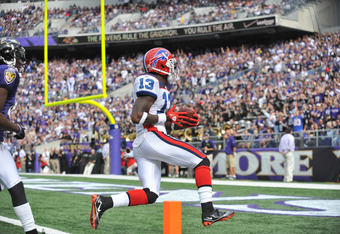
Bills Player Drops Ball, Blames God

The sports media is all over Buffalo Bills wideout Steve Johnson for dropping a potential game winning overtime pass yesterday against the formidable Pittsburgh Steelers, and then blaming god on his Twitter account. I watched the play unfold live and and screeched in horror at the gaffe because I don’t like the Steelers. The Bills went on to lose, but I have to say that Johnson’s postgame tweet almost makes up for it:

“I praise you 24/7!!! And this how you do me!!! You expect me to learn from this???How??? I'll never forget this!! Ever!! Thx Tho.”

How many times have we heard a football player praise god or Jesus for having a great game or making a game-winning score? A gazillion. How many times have we a heard a football player or any professional athlete blame the deity? Well, Johnson makes one. This is truly historic, like moon-landing historic. Like first artificial heart transplant historic. We need more Steve Johnsons not just in the NFL, but in everyday life. If more people start to think that their beloved god is working against them despite all their praying, then it’s only natural that there would be a turning away from the great dictator in the sky.

My only regret is that George Carlin did not live to see this day.


- Max

11.23.2010

Religion Does Not Make People Moral

The face of religious tomfoolery

Few things are lamer than attempts to demonstrate that religion is the foundation upon which moral behavior rests. Each new such endeavor seems to be as unconvincing as the last, with the same old tired canards being recycled in delusional ruminations about the necessity of divine approval in human relations. Such is the recent attempt by Boston Globe columnist Jeff Jacoby in a particularly puerile Op-Ed, whose claims should repulse any freethinker.

The best part about Jacoby’s column, is that in arguing for the necessity of a Biblical foundation of morality, he actually refutes himself, thoroughly might I add. Read the following passage, where Jacoby is describing and ridiculing the American Humanist Association’s secular ad campaign. He says the organization is being unfair by highlighting only the shockingly violent passages of the Bible to quote, even though such passages are everywhere and easy to find. In a paragraph that is totally self-defeating for his own case, Jacoby whines,

Of course anyone can cherry-pick quotes to make a point. And of course it is true, as the humanist group’s executive director Roy Speckhardt maintains, that there are “religious texts’’ that “advocate fear, intolerance, hate, and ignorance.’’ Religion has often been put to evil purposes or invoked to justify shocking cruelty. Then again, the same is true of every area of human endeavor, from medicine to journalism to philosophy to the law.

He then proceeds to blow a lot of hot air about why religious morality is necessary for civilization, but it’s all moot, because in these two brief throwaway lines inserted with the purpose of defending his position, he actually destroys it before he even really gets started. Jeff Jacoby, thank you for playing, your column is over.

It is over because he outright concedes the point that religion is a human endeavor often “put to evil purposes or invoked to justify shocking cruelty.”

Saying religion is a “human endeavor” could mean one of two things. It could mean that religion is a human invention, with its gods, lore, and moral customs outright fabricated by humans using some sort of vague and illusory divine sanction. Or, it could mean that religion is truly a divinely-inspired enterprise whose execution is nonetheless ultimately in the hands of imperfect humans who put religion “to evil purposes.”

As a believer in the Judeo-Christian tradition, Jacoby’s understanding of religion as a human endeavor falls into this latter category. Not only does he concede that religion is capable of inspiring horrific acts, he actually puts religion in a category with medicine, journalism, philosophy, and law—strictly “human” disciplines. Thus, in his attempt to elevate religion to the status of the sine qua non of morality, he paradoxically “lowers” it to the level of earthly studies. His point is to show that religion too, is not immune to the taint of human influence. But if this is true, then what is religion for? If religion is as corruptible and susceptible to pure sophistry as any other “human endeavor,” then it stands to reason that whatever moral rules are said to derive from religion could just as easily have arisen by nonreligious means. Despite Jacoby’s claim that the secular ad campaign “cherry-picks” Bible passages that are especially abhorrent, the Bible is rife with instances of objectionable behavior by both humans and the heavenly father. It contains innumerable acts and instructions which no reasonable person could condone or follow. We do not stone those who work on the Sabbath. We do not kill those who practice witchcraft. We do not regard our women as chattel like the Tenth Commandment would have us. We do not punish those who hold different religious beliefs. We do not adhere to the lesser known commandment that we mustn’t wear clothing woven from two different materials. We do not allow our enemies to strike us without us striking back. And the reason we do not follow these and countless other commands—even though they are in the Bible—is because they are ridiculous and wrong. Members of the Judeo-Christian faiths “cherry-pick” from the Bible all the time, and we should be thankful for that. Otherwise our society would be characterized by a horrifying authoritarianism that regulates virtually every last detail of human behavior. The plain fact that not even Jews and Christians adhere fully to the Bible’s diktats is the clearest evidence that humans are capable of constructing a morality which is independent of revealed wisdom.

These considerations render Jacoby’s argument senseless blather, and his subsequent remarks contain all the intellectual rigor of a game of tic-tac-toe.

The truth is, people are not good because of religion. They are good despite religion. Believers tend to be more moral than the religions they practice, as shown by their unwillingness to adhere to the more despicable maxims which comprise their respective faiths. We may thank someone for that.

Just not god.


- Max

11.19.2010

Gearing Up For The War On Christmas

Alright, let’s do this.

It’s that time of year once again when opponents of the separation of church and state decry…well…the separation of church and state. Christmas season provides no shortage of Christian zealots wishing to foist their iniquitous hocus pocus on others by using the public forum to display apocryphal scenes from Biblical lore and to spread the fraudulent words of their huckster messiah.

The inevitable and Constitutionally-minded secular pushback against such ignoble and illegal buffooneries will be met with perfunctory revulsion and shocking disbelief by those who are Holier than Thou. Editorial pages of the conservative press will be rife with indignation at the offense to this great “Christian nation.” Fox News anchors and like-minded media personalities everywhere will feature a seemingly endless parade of segments announcing that “the war on Christmas” is once again under way, with the godless factions “mounting this surge because they are aware that they have a large, untapped army of potential troops.” Christmas indeed seems to be under attack. Or so we are being told.

But the media, far from overstating the atheist objective as I understand it, actually undersells the broader objectives of the freethought movement. What I envision is not a war on Christmas, but a war on Christianity and religion in general. I am not content with merely keeping a nativity scene off the public grounds. That is but one minor skirmish in the wider war on superstition, gullibility, ignorance, and bigotry. If this writer had his druthers, no one would belong to any religion anywhere. That is not to say I am desirous of imposing nonbelief on the faithful. Far from it. The shedding of religious belief must be undertaken by one’s own volition, which is actually anathema to the manner in which religion itself afflicts human minds. Typically religion is simply inculcated on children who know no better than what their parents and mischievous clergy tell them. And that is how religion in the 21st century must survive: through early indoctrination and general social sanction. Religion has no real merits of which to speak.

Neither Christianity nor any other faith can withstand the rigors of intellectual honesty and scrutiny. Indeed, one suspects that the religionists are so sensitive to perceived assaults on their faith because on some level they surely know that their beliefs are logically indefensible. Religion is therefore inherently weak, and this fact should encourage those who wish to see it destroyed. And be destroyed it must.

- Max

10.28.2010

I Really Hate "God Bless America"

Yuck.

One of the bad things about the September 11th attacks, other than the mass death, destruction, the resulting wars, and the low interest rates that spawned the housing market collapse and subsequent decimation of the banking sector and economy in general, is how the attacks have affected Major League Baseball.

I’m a baseball guy, and even though my Red Sox have been conspicuously absent from this year’s playoffs, I’ve watched most of the postseason games. There are a lot things that piss me off about the playoffs this year: the insufferable broadcasting duo of Joe Buck and Tim McCarver; the insufferable broadcasting trio of Ernie Johnson, Ron Darling, and John Smoltz; and of course, the marathon length of these games. With the season on the line, managers understandably pull out all the stops and play the percentages. It isn’t uncommon in the postseason to have three or four different pitchers see action in a single inning. And all those pitching changes add up. And I swear the breaks in between innings are longer in the playoffs than in the regular season.

So what’s MLB’s solution to these long-ass games, all of which start at 8pm or later on the east coast and don’t end until midnight or later? They play God Bless America during the seventh inning of every fucking postseason game. Awesome. Way to add game time by injecting a completely irrelevant relgio-nationalistic anthem into the middle of the fucking ballgame.

During the regular season, MLB teams typically play God Bless America only on Sundays. And that’s strange, since people are asking god to bless America on his day off, which seems rather presumptuous. At Yankee Stadium, the hymn is performed during every game. During some of these renditions, fans have been literally prevented from moving around freely by stadium security, which is some seriously fascistic shit. But this postseason, some person or persons, somewhere, decided it would be best if this terrible song were sung during the seventh inning of every playoff game. And don’t forget, the national anthem is already sung before the game. Isn’t that enough for all you armchair patriots, you jingoistic fucks?

The last time I was at Fenway Park on a Sunday and they asked the crowd to rise for God Bless America, I remained seated for the whole song. Fuck ‘em. But I had no problem standing up immediately afterwards for the seventh inning stretch and “Take me out to the ballgame,” which is a song that predates God Bless America by the way. I imagine that many people around me thought I was being an asshole by not standing. No one said anything of course, because they were undoubtedly too chickenshit. This country is full people who think that being a great American means pledging allegiance to the flag, wearing an Old Glory pin on your lapel, supporting the latest war in a vast sandbox that just happens to sit atop a giant pool of oil, and generally thinking that your country is better than every other. And when you’re attending some apolitical event, like a baseball game, which is supposed to be a brief escape from the harsh realities of politics and life in general, and you’re told to stand and ask god to bless America, well you do that too. Why? Out of respect. Whatever the fuck that means. It’s like during the Iraq war when people slapped a yellow ribbon magnet on the back of their SUVs that read “Support the Troops.” (Apparently the irony was lost on most people.) And that was good enough. Sure maybe you voted for politicians whose idea it was to start the war in the first place, and sure maybe you voted for politicians who wanted to slash the benefits of the soldiers who made it out alive, but I mean, Jesus, you had the fucking sticker on the back of your car! What more could you have done?

I think I’m in the minority on this one. Most Americans believe in god, and sports fans are typically conservative, which is no surprise when you consider all the macho posturing that goes on in sports. I wrote an email to the Red Sox a couple of months ago asking if they planned on doing away with God Bless America at some point, and I haven’t received a response. The answer, sadly, is probably never, because the ownership of the Red Sox, just like every other in MLB, doesn’t have the balls to acknowledge the sheer pointlessness of the song and pull the fucking plug on it.


- Max

6.15.2010

Score One For Zeus!


Awesome news out of Ohio. The regionally-famous “Touchdown Jesus” statue off I-75 was struck by lighting and got its shit ruined. Let’s see the Jesus freaks try to explain away this one.

- Max

LinkWithin

Related Posts with Thumbnails